I've had some thoughts on what an LL campaign would look like if I were to run one, which have been further inspired by seeing the amazing Black Death film yesterday. In brief, I'd very much like to emphasise the battle between the alignments - Law, Neutrality and Chaos, and even envisage a plausible justifcation for alignment languages... I'll write more about that idea another time.
Sunday, 22 August 2010
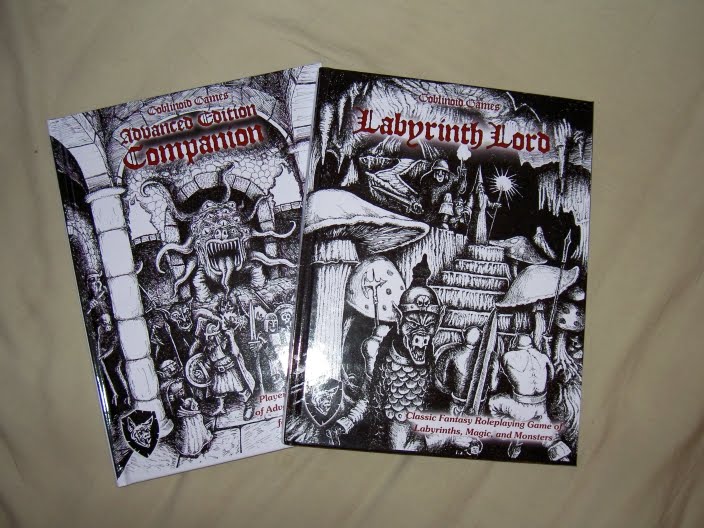
New arrivals!
I've had some thoughts on what an LL campaign would look like if I were to run one, which have been further inspired by seeing the amazing Black Death film yesterday. In brief, I'd very much like to emphasise the battle between the alignments - Law, Neutrality and Chaos, and even envisage a plausible justifcation for alignment languages... I'll write more about that idea another time.
Labels:
film,
labyrinth lord
Tuesday, 10 August 2010
Hirelings & Henchmen
Hirelings and henchmen play a significant role in old-school D&D, and I wanted to encourage their use in my Savage Worlds campaign. I thought this was an especially good idea due to the Savage Worlds system being able to so smoothly handle large numbers of characters in combat. However, unfortunately I couldn't find any details in SWEX or the Fantasy Companion relating to the hiring of allies - not even a rough "cost per day / week". So I worked out my own tables, specific to fantasy settings, with guidelines for the costs of locating and hiring mercenaries and neophyte adventurers to join a party.
The PDF can be downloaded here: Hirelings & Henchmen.
It includes a random table for determining an adventurer's profession (Fighter, Wizard, Thief, Cleric, etc), and stats for them all. All the adventurers' stats are created with 5 points in Attributes, 10 points in Skills, and no Edges except those granted by racial background. So they're a step behind starting PCs, which is appropriate.
At present there are no guidelines or tables for hirelings' background, personality or motivations. The table in SWEX can provide a basic hint at personality, but I'd like to add some tables with small snippets of background, motivations and interesting quirks or features. A simple roll on the Minor Hindrances table could add some flavour as well.
The document is somewhat idiosyncratic to my campaign, with a setting-specific list of deities for Clerics, and the assumption that all Elves have supernatural powers. These things can easily be ignored though.
The PDF can be downloaded here: Hirelings & Henchmen.
It includes a random table for determining an adventurer's profession (Fighter, Wizard, Thief, Cleric, etc), and stats for them all. All the adventurers' stats are created with 5 points in Attributes, 10 points in Skills, and no Edges except those granted by racial background. So they're a step behind starting PCs, which is appropriate.
At present there are no guidelines or tables for hirelings' background, personality or motivations. The table in SWEX can provide a basic hint at personality, but I'd like to add some tables with small snippets of background, motivations and interesting quirks or features. A simple roll on the Minor Hindrances table could add some flavour as well.
The document is somewhat idiosyncratic to my campaign, with a setting-specific list of deities for Clerics, and the assumption that all Elves have supernatural powers. These things can easily be ignored though.
Labels:
dnd,
hirelings,
random tables,
savage worlds
New character sheets
I've just finished some first draft character sheets:
- Allies (up to 6 on one sheet)
- Magic-user character sheet back, with space for equipment, notes and spells
- General character sheet back, with space for equipment, notes and two allies
Labels:
character sheets,
savage worlds
Saturday, 31 July 2010
Intervention by deities
So I've been browsing through the AD&D DMG, and I must say I'm really impressed with it so far. "1e" has the reputation of being overly complex, arcane and difficult to understand, but I've not found it any more complex than 2e was, say. The "rules" section of the book (and that includes all sorts of guidance and examples, not just hard rules) only encompasses 119 pages - the rest being magic item descriptions and various random tables.
Anyway, I'll probably write here about anything I read that particularly grabs my attention. One such thing was the presence of the following two sentences, amidst the section on INTERVENTION BY DEITIES:
Serving some deity is an integral part of AD&D. ...the accumulation of hit points and the ever-greater abilities and better saving throws of characters represents the aid supplied by supernatural forces.That's something that's never occurred to me before! And I don't think most people play that way, nowadays at least. (I'm not sure how many people would have taken those sentences literally back in the day, either.) But taking those sentences literally is a really interesting proposition, I think. What if every character, not just clerics and paladins, were required to choose a patron deity, and that that patronage is required in order to advance past 5th or so level. Like, normal people can advance up to a certain degree, but it requires the patronage of a deity to attain the abilities of higher level characters. That sounds like a pretty interesting premise for a campaign to me!
AD&D Dungeon Master's Guide
I've just had a flick through it, to see what's in there (I've not looked at the 1st edition DMG for quite a few years), and was delighted. I'm especially pleased by the huge number of random tables for all manner of things: NPC personalities, dungeon dressing, treasure, tricks & traps, etc etc.
It's going to be a fun read!
Labels:
adnd,
random tables
Treasure tables
I've been thinking about creating some more detailed random treasure hoard tables for Savage Worlds, as a kind of expansion to the system given in the Fantasy Companion. The rules there go into incredible depth for randomly selecting magic items (as is traditional in fantasy RPGs), but all other treasure is described simply as "Silver & Gold". Which definitely has the advantage of simplicity. However I personally rather like to at least have the opportunity to roll on tables for gems, jewellery, books, maps, and other miscellaneous items of value. I like the feeling this gives to a campaign - that the PCs aren't just racking up chests full of gold pieces - that a painting or a bracelet or a pouch of herbs are all valuable too. So far this is what I've thought:
I'd like to keep the simplicity of the system, by determining the total value of a treasure hoard, excluding magic items, by just rolling 1d10 and multiplying by the magnitude of the hoard. So that'd be the first step, as normal. But then it'd be nice, once the total value has been determined, to have some more tables to roll on to determine exactly what the valuable items are. Something like:
Hoard contents (1d6):
1-3 Just coins
4-5 Coins + one valuable item
6 Coins plus multiple valuable items
For a hoard with one or more valuable items, we need to determine what proportion of the hoard's total value is made up of coins, and what proportion is made up of the valuable items. A simple system is to say that the extra items are worth d10 x 10% of the hoard's total value. The remainder is coins.
Obviously if a hoard contains just one valuable item, its value can be easily calculated. Multiple items have proportional values as follows:
Multiple items' proportional value (1d6):
1 Two items - 50 / 50
2 Two items - 25 / 75
3 Two items - 10 / 90
4 Three items - 33 / 33 / 33
5 Three items - 20 / 40 / 40
6 Three items - 10 / 10 / 80
An example:
A Worthwhile treasure hoard has a total value of 1d10 x $100. Say we roll a 7, meaning that it's worth $700. We then roll to see if there are any special valuable items in the treasure hoard. A roll of 1d6 results in a 6 - multiple valuable items. 1d10 is rolled to determine what proportion of the hoard's value is made up by these valuable items - a result of 5 means 50% = $350. A further roll of 1d6 - resulting in a 3 - denotes that there are two valuable items, with proportional values of 10% / 90% of the valuable items sub-total (i.e. $35 and $315).
So the hoard contains $350 worth of coins, an item worth $35 and an item worth $315.
Well, perhaps that all sounds a bit complicated. But I think it'd work smoothly enough in practice, and I can't think of anything easier for now!
Of course there'd also need to be a set of tables to determine what exactly these "valuable items" are! This is the fun bit. Here's a simple table for starters:
Valuable items (1d8):
1 Gems
2 Jewellery
3 Books
4 Maps
5 Art / furnishings
6 Fur / cloth
7 Herbal / alchemical
8 Mundane
I'd like to keep the simplicity of the system, by determining the total value of a treasure hoard, excluding magic items, by just rolling 1d10 and multiplying by the magnitude of the hoard. So that'd be the first step, as normal. But then it'd be nice, once the total value has been determined, to have some more tables to roll on to determine exactly what the valuable items are. Something like:
Hoard contents (1d6):
1-3 Just coins
4-5 Coins + one valuable item
6 Coins plus multiple valuable items
For a hoard with one or more valuable items, we need to determine what proportion of the hoard's total value is made up of coins, and what proportion is made up of the valuable items. A simple system is to say that the extra items are worth d10 x 10% of the hoard's total value. The remainder is coins.
Obviously if a hoard contains just one valuable item, its value can be easily calculated. Multiple items have proportional values as follows:
Multiple items' proportional value (1d6):
1 Two items - 50 / 50
2 Two items - 25 / 75
3 Two items - 10 / 90
4 Three items - 33 / 33 / 33
5 Three items - 20 / 40 / 40
6 Three items - 10 / 10 / 80
An example:
A Worthwhile treasure hoard has a total value of 1d10 x $100. Say we roll a 7, meaning that it's worth $700. We then roll to see if there are any special valuable items in the treasure hoard. A roll of 1d6 results in a 6 - multiple valuable items. 1d10 is rolled to determine what proportion of the hoard's value is made up by these valuable items - a result of 5 means 50% = $350. A further roll of 1d6 - resulting in a 3 - denotes that there are two valuable items, with proportional values of 10% / 90% of the valuable items sub-total (i.e. $35 and $315).
So the hoard contains $350 worth of coins, an item worth $35 and an item worth $315.
Well, perhaps that all sounds a bit complicated. But I think it'd work smoothly enough in practice, and I can't think of anything easier for now!
Of course there'd also need to be a set of tables to determine what exactly these "valuable items" are! This is the fun bit. Here's a simple table for starters:
Valuable items (1d8):
1 Gems
2 Jewellery
3 Books
4 Maps
5 Art / furnishings
6 Fur / cloth
7 Herbal / alchemical
8 Mundane
Labels:
random tables,
savage worlds,
treasure
Wednesday, 28 July 2010
Tower of the mad archmage
In a diversion from the usual events of the campaign, in last night's session (arranged to coincide with Gary Gygax's birthday) the PCs had an odd encounter with a tower which erupted abruptly from the ground near to where they were camped. Being keen adventurers they went to investigate it, and discovered it to be part of the castle of the mad archmage Zagyg. Of course they climbed inside, through an accessible window, and had a marvellously old-school time looting and pillaging! :) This was much to the dismay of the inhabitants of the castle - white-furred ape guards, floating eye spheres, and an amusingly non-violent group of robed figures who did nothing but flee in fear of the band of armed raiders.
Labels:
gary gygax,
session summaries
Subscribe to:
Posts (Atom)